
RevBio, Inc., has published peer reviewed results of a study in NPJ Microgravity, an open-access journal from the Nature portfolio, showing that its regenerative bone adhesive, TETRANITE®, promotes localized new bone growth in a microgravity environment where the ability to regenerate new bone tissue is significantly compromised.1 A key objective of the study was to compare the ability of TETRANITE, a patented regenerative biomaterial, to generate new bone compared to a bone morphogenic protein (rhBMP-2) known by the trade name INFUSE® which is manufactured by Medtronic plc.
This press release features multimedia. View the full release here: https://www.businesswire.com/news/home/20260831323247/en/
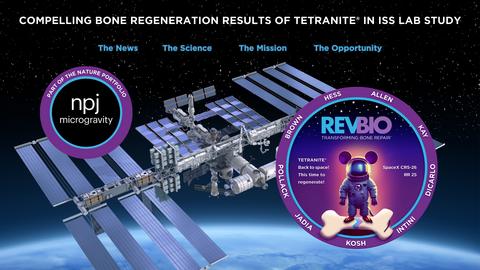
“We observed that TETRANITE promotes bone regeneration within the limits defined by the anatomical structure while rhBMP-2 stimulates an excessive amount of bone formation,” said Guiseppe Intini, D.D.S., Ph.D., Associate Professor of Periodontics and Preventive Dentistry at the University of Pittsburgh and faculty member at the McGowan Institute for Regenerative Medicine. Dr. Intini led the team of researchers who conducted this experiment.
To conduct the experiment, forty mice were flown under sponsorship of the International Space Station National Laboratory (ISS National Lab) to the orbiting outpost on SpaceX’s 26th Commercial Resupply Services mission (contracted by NASA). Prior to launch, critically sized surgical defects were created in the cranial bone of the mice and treated with either TETRANITE, rHBMP-2, or left empty to act as an experimental control. NASA studies have proven that astronauts lose between 6%-12% of their bone mineral density during a typical 6-month mission in microgravity conditions.2 This research was funded by the Center for the Advancement of Science in Space, Inc. (CASIS), which manages the ISS National Lab.
While this study focused on a cranial application of TETRANITE, orthobiologic products such as rhBMP-2 have been primarily used for regenerating bone in the spine. Before serious safety concerns surfaced due to the excessive amount of bone it creates, INFUSE generated over $800 million in annual revenue for Medtronic primarily from spine applications.3 Overall, the global spine market for orthobiologics is projected to grow to $5.21 billion by 2031. In other recently published literature, TETRANITE has been shown to be highly effective for regenerating bone in the spine compared to other bone grafting materials.4
“Surgeons have long desired a regenerative bone adhesive that can grow new bone as effectively as rhBMP-2, but without the risk of migration, extravasation, and the potential for other serious adverse events,” said Brian Hess, CEO of RevBio. “We see the unlimited commercial potential of TETRANITE to improve clinical outcomes for patients across a broad range of musculoskeletal indications.”
About RevBio, Inc.
RevBio, Inc., is a clinical stage medical device company engaged in the development and commercialization of TETRANITE®, a patented, synthetic, injectable, self-setting, and osteoconductive bone adhesive. The company is initially developing this technology for use in the dental, cranial, and broader orthopaedic markets as well as applications in the animal health market. RevBio’s TETRANITE technology is not yet approved for commercial use.
About Nature
Nature is a weekly international journal publishing the finest peer-reviewed research in all fields of science and technology based on originality, importance, interdisciplinary interest, timeliness, accessibility, elegance and surprising conclusions. Nature also provides rapid, authoritative, insightful and arresting news and interpretation of topical trends affecting science, scientists, and the wider public.
1 Di Carlo, Roberta, Uzma Mhate, Luigi Mancinelli, Sourabh Boruah, Taiana C. Leite, Xuehui Geng, Michael C. Brown et al. “A novel mineral-organic bone adhesive promotes calvarial bone regeneration in microgravity conditions.” npj Microgravity (2026).
2 Fiedler, Benjamin, Todd Phillips, Jad J. Lawand, Cameron Noorbakhsh, Abdullah N. Ghali, Jeffrey Hauck, and Adil S. Ahmed. “Bone Health in Space Flight: Incomplete Bone Mineral Density Convalescence at 1 Year Post mission Without Increased Fracture Risk.” JAAOS Global Research & Reviews 9, no. 11 (2025): e25.
3 James, Aaron W., Gregory LaChaud, Jia Shen, Greg Asatrian, Vi Nguyen, Xinli Zhang, Kang Ting, and Chia Soo. “A review of the clinical side effects of bone morphogenetic protein-2.” Tissue Engineering Part B: Reviews 22, no. 4 (2016): 284-297.
4 Foley, Kevin T., Eric J. Woodard, Jonathan R. Slotkin, Ben Gadomski, Caroline D. Woodard, Michael C. Brown, and Brian J. Hess. “Assessment of Bone Bridging of a Novel Wet-Field Regenerative Bone Adhesive for Lumbar Spine Fusion in an Ovine Model at 12, 26, and 52 Weeks.” International Journal of Spine Surgery (2026).
View source version on businesswire.com: https://www.businesswire.com/news/home/20260831323247/en/
Media gallery


