

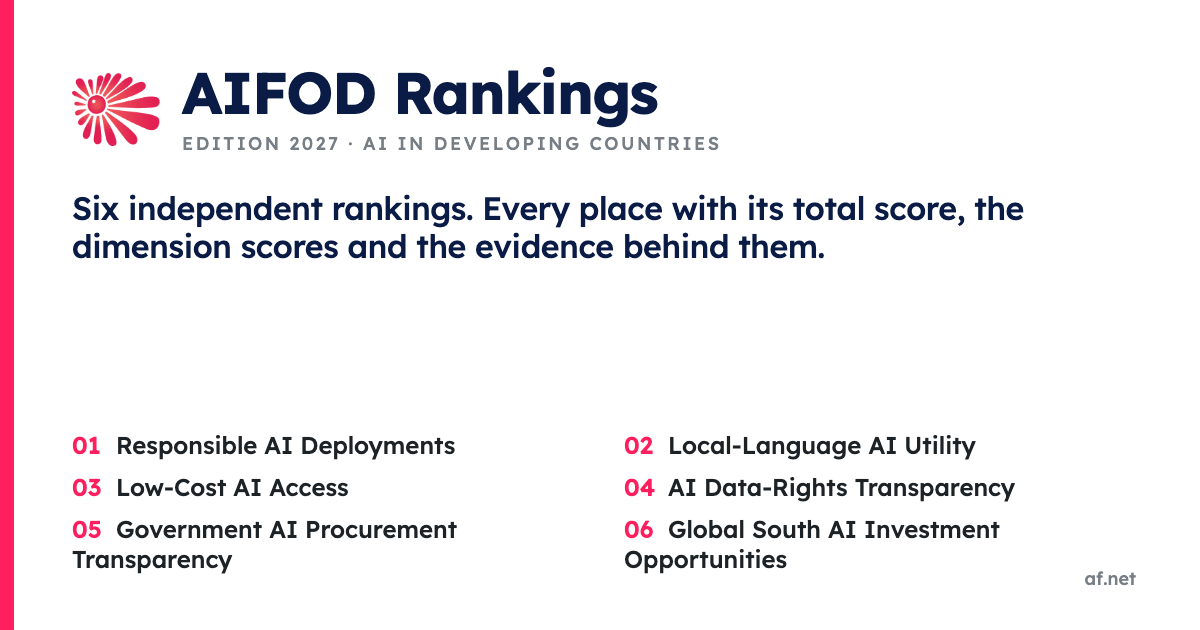
Vienna, Wien Nov 25, 2026 (Issuewire.com) Farmer.Chat, the AI farm advisory service built by Digital Green Foundation, has placed first in Responsible AI Deployments in the Global South, the flagship ranking of the AI for Developing Countries Forum (AIFOD). This first edition compares AI tools that help smallholder farmers identify crop diseases, and asks which of them already solve a real problem for the people using them.
Pests and plant diseases destroy between 20 and 40 percent of global crop production every year, according to the UN Food and Agriculture Organization (FAO). AIFOD reviewed 58 tools in use across Africa, South Asia, South-East Asia and Latin America. Forty-seven are ranked; nine, about one in six, had too little public evidence, and two were removed after review.
The top ten:
- Farmer.Chat (Digital Green Foundation), 84.2. Answers farmers’ questions from text, voice and crop photos, in programmes across India, Ethiopia, Kenya, Nigeria, Brazil and other countries. Digital Green reports that it reaches nearly 3 million farmers (July 2026); a registered randomised trial led by IFPRI researchers in Nakuru County, Kenya, runs until March 2027. Highest-scoring dimension: verifiable use and outcomes (88).
- PlantVillage+, formerly PlantVillage Nuru (Pennsylvania State University / PlantVillage+ Inc.), 79.5. In a 2020 peer-reviewed study in Tanzania, Nuru was 7488% accurate when six leaves per plant were checked for cassava mosaic, brown streak and green mite damage; in a separate image test it outperformed extension officers and farmers. The current app lists more than 40 countries. Highest-scoring dimension: replicability in similar regions (90).
- Plantwise Data Collection (CABI), 76.3. Used by plant doctors at plant health clinics to record diagnoses online or offline and send advice to farmers by text message. Highest-scoring dimension: verifiable use and outcomes (86).
- Pl@ntNet (a consortium of CIRAD, Inria, INRAE and IRD), 74.3. A plant identification platform whose mobile app offers downloadable models for offline use. Highest-scoring dimension: price and barriers to use (84).
- Plantix (PEAT GmbH), 69.9. Identifies crop diseases, pests and nutrient deficiencies from photos, with more than 10 million downloads. It was tailored with ICRISAT for Andhra Pradesh and piloted by CABI’s Plantwise programme in Tamil Nadu. Highest-scoring dimension: verifiable use and outcomes (88).
- DeHaat Kisan (Green Agrevolution, India), 63.1. Farmers send crop photos to agri experts, with a target response time under 30 minutes. Highest-scoring dimension: price and barriers to use (78).
- SPIDTECH (University of the Philippines Los Baños), 62.9. Offline pest and disease diagnosis for nine crops; it recorded more than 5,600 registered users in 81 Philippine provinces between 2019 and 2021. Highest-scoring dimension: price and barriers to use (78).
- Tumaini (Alliance of Bioversity International and CIAT), 62.0. On-phone diagnosis for banana and, since 2024, bean; the Alliance reports 7099% accuracy depending on plant part and disease. Highest-scoring dimension: price and barriers to use (78).
- AgroStar (ULink AgriTech, India), 61.2. An agri-doctor app in 11 Indian languages with more than 5 million downloads; it works offline and on 2G and 3G networks, and farmers post crop photos to its community for advice. Highest-scoring dimension: price and barriers to use (88).
- KilimoAI (Nelson Mandela African Institution of Science and Technology, Tanzania), 60.2. An Android app that diagnoses crop diseases from leaf photos, with a Swahili interface, developed with input from farmers and the Tanzania Agricultural Research Institute. Highest-scoring dimension: local users in the design (82).
What the ranking shows. The weakest area across all 47 ranked tools was replicability in similar regions, with an average score of 23 out of 100; 24 tools published no evidence that would let another region reuse them. Handling of errors averaged 44. Price and barriers to use scored best, at 66. Most tools are cheap to try; far fewer show what happens when a diagnosis is wrong, or how another country could adopt them.
Tools were scored on verifiable use and outcomes (30%), involvement of local users in design (20%), price and barriers to use (15%), data and user rights (15%), handling of errors (10%) and replicability in similar regions (10%). Agriculture, health and education tools are never ranked against each other.
“The tools at the top are not the ones with the most impressive models. They are the ones with evidence that farmers used them and were better off,” said Tianze Zhang, Founder of AIFOD. “We would like every team building for smallholders to publish that evidence.”
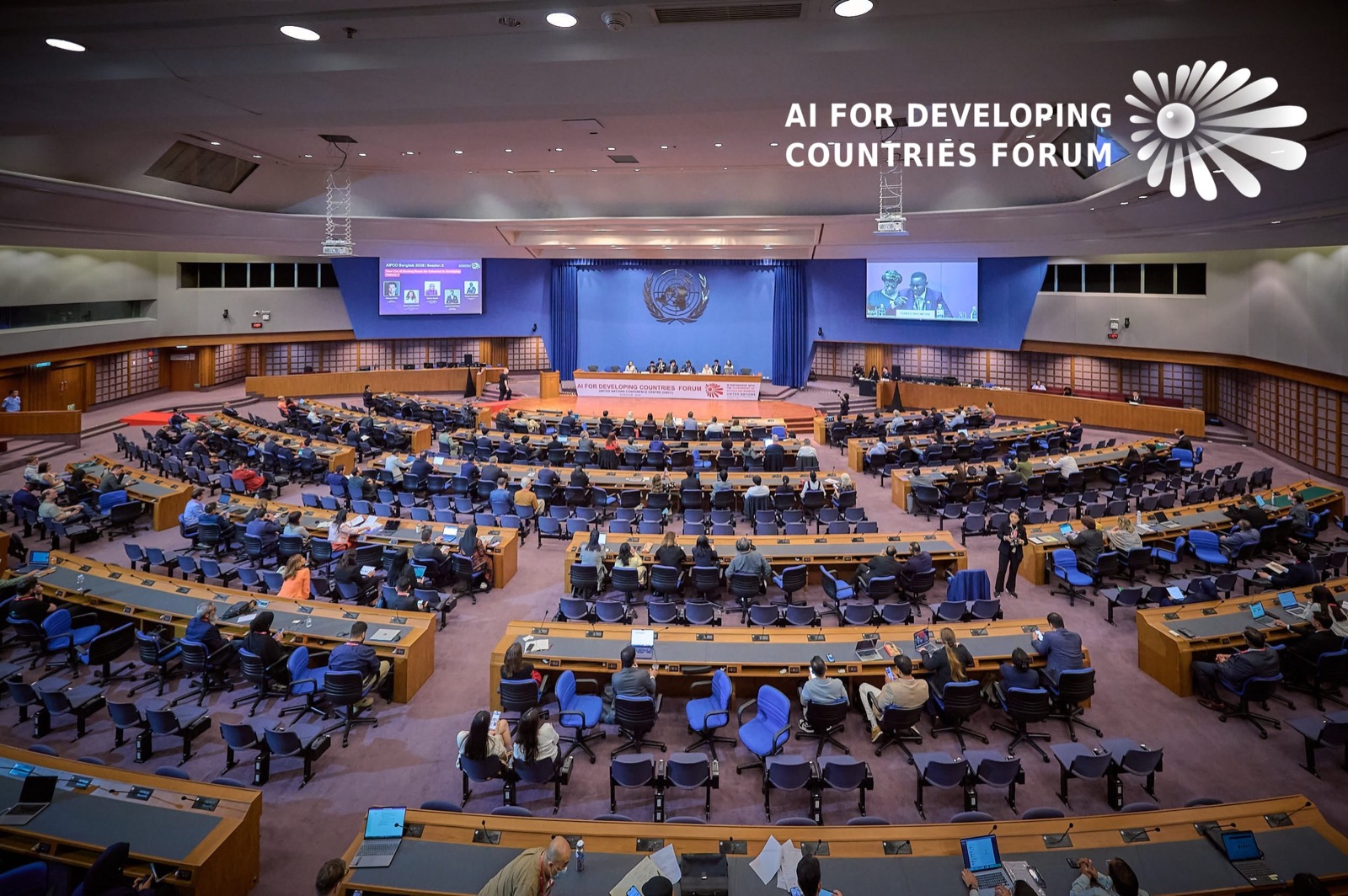
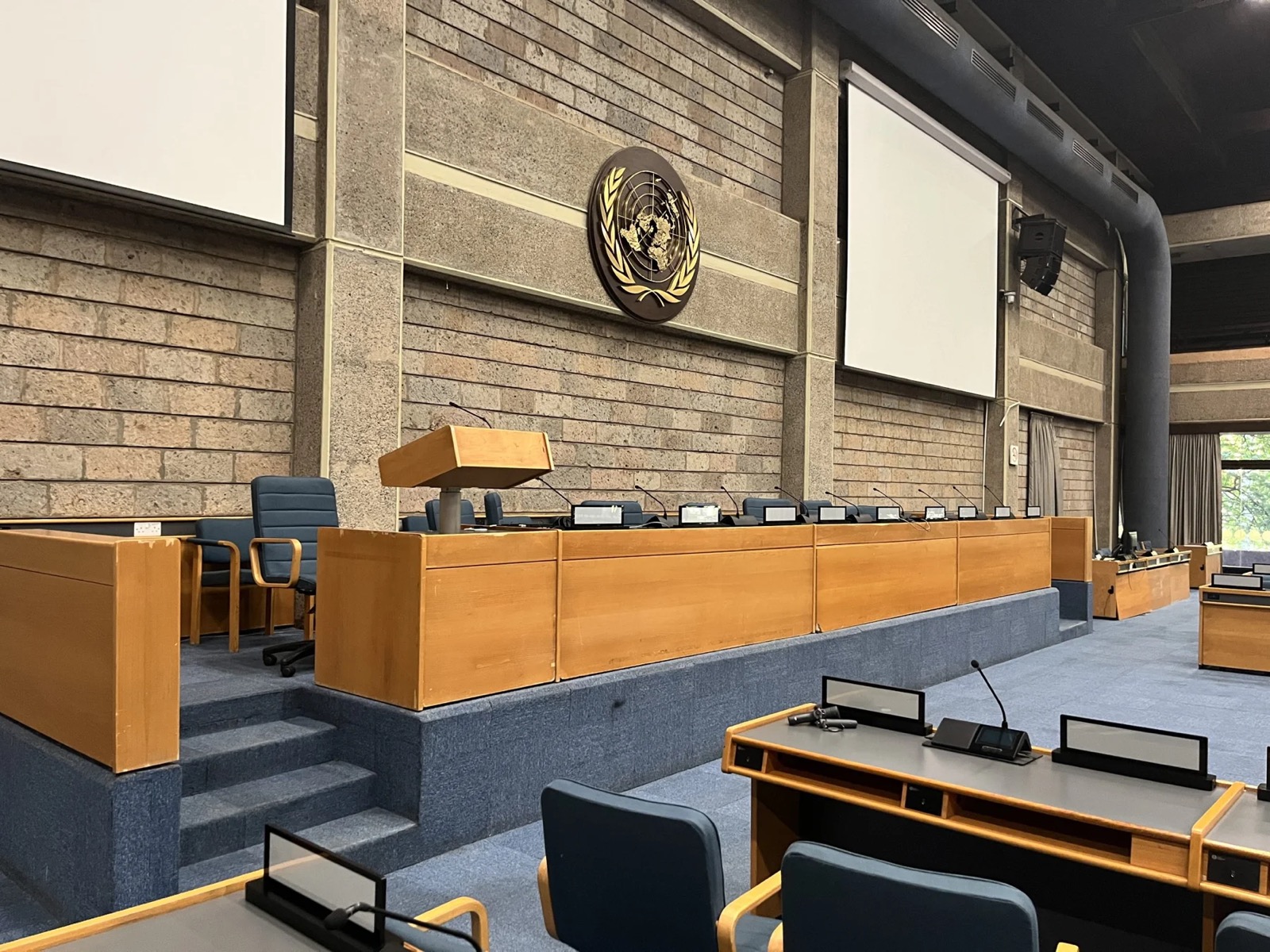
The ranking reflects the values AIFOD works by: an independent voice for the Global South, bridges between governments and industry, collaboration rather than confrontation, and ideas judged on merit rather than status. AIFOD’s work is aligned with the UN Sustainable Development Goals, and this ranking speaks to Goal 2, Zero Hunger. Agricultural researchers, extension services and tool developers are invited to the AIFOD Nairobi Summit, held 1719 February 2027 at the United Nations Office at Nairobi; applications are open at af.net/nairobi.
For developers of farm tools, FAIR, AIFOD’s certification for small AI companies in developing markets, asks the questions farmers and governments care about: was the community’s free, prior and informed consent obtained, are local partners and jobs part of the work, how is farmers’ data handled, and does the benefit last beyond the project. Applying is free, certified systems are listed in the public FAIR Registry at fair.af.net, and FAIR status appears in ranking profiles as a fact but never adds points.
About the ranking. Scores are based on public evidence available on 8 October 2026 and were checked by independent reviewers. Developers may submit corrections to info@af.net at any time. AIFOD funds the research itself; no developer pays for inclusion or previews results. Full scores, evidence and sources are published at af.net/rankings under a CC BY 4.0 licence.
About AIFOD. The AI for Developing Countries Forum (AIFOD), registered in Switzerland and Austria, promotes the ethical and inclusive use of AI across the Global South through certification, capacity sharing, technology transfer and international cooperation. It has more than 7,300 members in over 150 countries. Its next summit takes place 1719 February 2027 at the United Nations Office at Nairobi.
Source :AI for Developing Countries Forum (AIFOD)
This article was originally published by IssueWire. Read the original article here.