Halifax, Nova Scotia – June 05, 2026 – PRESSADVANTAGE –
SolarEnergies.ca has published a new article examining Calgary’s emerging balcony solar campaign and what it reveals about Canada’s unfinished rules for plug-in solar systems. The article, titled “Calgary Balcony Solar Campaign Pushes Canada to Create Plug-In Solar Rules,” focuses on renters, condo residents, homeowners, and policymakers trying to understand whether small balcony solar systems can become a practical clean energy option in Canada.
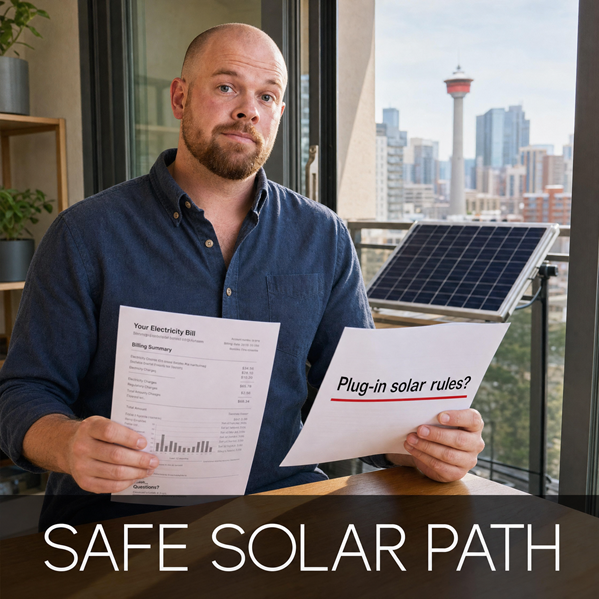
The article responds to a June 2026 campaign led by Calgary Climate Hub, Climate Reality Canada, Calgary ACORN’s City Centre chapter, and Norfolk Housing Association. The campaign calls for clearer rules around plug-in balcony solar, a category of small solar systems that can be mounted on balconies or patios and connected through a microinverter. SolarEnergies.ca explains that the technology itself is not the hard part. The challenge is Canada’s approval path, which still does not treat plug-in balcony photovoltaic systems as a simple consumer product category.
Vitaliy Lano, owner of SolarEnergies.ca and the publication behind “Canada Goes Solar,” stated that the campaign is important because it brings renters and condo owners into a solar conversation that has often focused on detached homeowners.
“Balcony solar is not going to replace a full rooftop solar system,” Lano stated. “But it asks a fair question: should people who rent, live in apartments, or do not control their roof have any safe and legal way to generate a small amount of their own electricity?”
The SolarEnergies.ca article notes that Alberta advocates say balcony solar can be technically legal, but current approval requirements can make small systems impractical. Alberta’s micro-generation process can involve utility applications, electrical contractors, permits, site plans, and interconnection agreements. That structure makes sense for larger rooftop systems, but it can become too heavy for an 800-watt balcony setup.
The article also highlights the campaign-modelled numbers from Plug-In Solar for Canada. The campaign estimates that an 800W south-facing balcony system could produce about 735 kWh per year and save about $58 per year. SolarEnergies.ca stresses that this is a campaign model, not a utility guarantee. Real output would depend on electricity rates, balcony direction, shade, mounting angle, export treatment, and local rules.
Lano commented that the savings number should be treated honestly.
“The modelled savings are modest, and that is actually useful for readers,” Lano said. “It stops the hype. Balcony solar is mainly an access issue. It gives renters and condo owners a way into solar, but it is not the same financial tool as a properly sized rooftop system.”
The article also separates portable off-grid solar panels from grid-connected plug-in PV systems. A portable panel charging a battery is different from a device feeding electricity into household wiring. SolarEnergies.ca explains that plug-in solar raises safety questions around overload, exposed plugs, incorrect installation, weather exposure, and anti-islanding, which is the function that shuts a solar inverter off when the grid goes down.
The analysis points to recent work in the United States, where UL Solutions launched a plug-in solar testing and certification framework based on UL 3700. SolarEnergies.ca argues that Canada already has PV and inverter safety standards, but still needs a clearer pathway for plug-in balcony PV as a consumer product class, including certified equipment, utility treatment, building approval, and safety rules scaled to small systems.
The article also outlines three practical barriers renters and condo owners face: electrical approval, utility approval, and building approval. Even if a product becomes certified, landlords, condo boards, strata councils, insurers, and local utilities may still affect whether a system can be installed.
Lano added that this is where the Calgary campaign could matter beyond Calgary.
“A workable policy has to protect people from unsafe wiring and bad installations, but it also has to avoid a blanket no,” Lano added. “If every small system is treated like a full rooftop project, renters will stay locked out of solar by design.”
For homeowners, the article makes a separate point: rooftop solar remains the stronger option where the roof is owned, suitable, and financially sensible. A balcony kit may produce hundreds of kWh per year, while a properly sized rooftop solar system can produce thousands, depending on location, roof angle, shade, and system size. SolarEnergies.ca encourages homeowners to compare detailed quotes, review equipment and warranty terms, and use its solar panel calculator before making a decision.
###
For more information about Solar Energies In Canada SEIC, contact the company here:
Solar Energies In Canada SEIC
Vitaliy Lano
2368680609
admin@solarenergies.ca