Logistics company shares lessons from recent customer onboarding reviews and outlines a broader approach to verifying prospective freight customers
CHICAGO, IL, UNITED STATES, August 21, 2026 /EINPresswire.com/ — Cargoos Logistics is encouraging freight brokers and transportation providers to take a multi-layer approach to customer verification after a recent internal review highlighted the importance of validating information across multiple independent sources.
The announcement follows Cargoos’ recent discussion of customer-side risk within freight transactions and the need for brokers to verify prospective customers and authorized representatives with the same care increasingly applied to carrier verification.
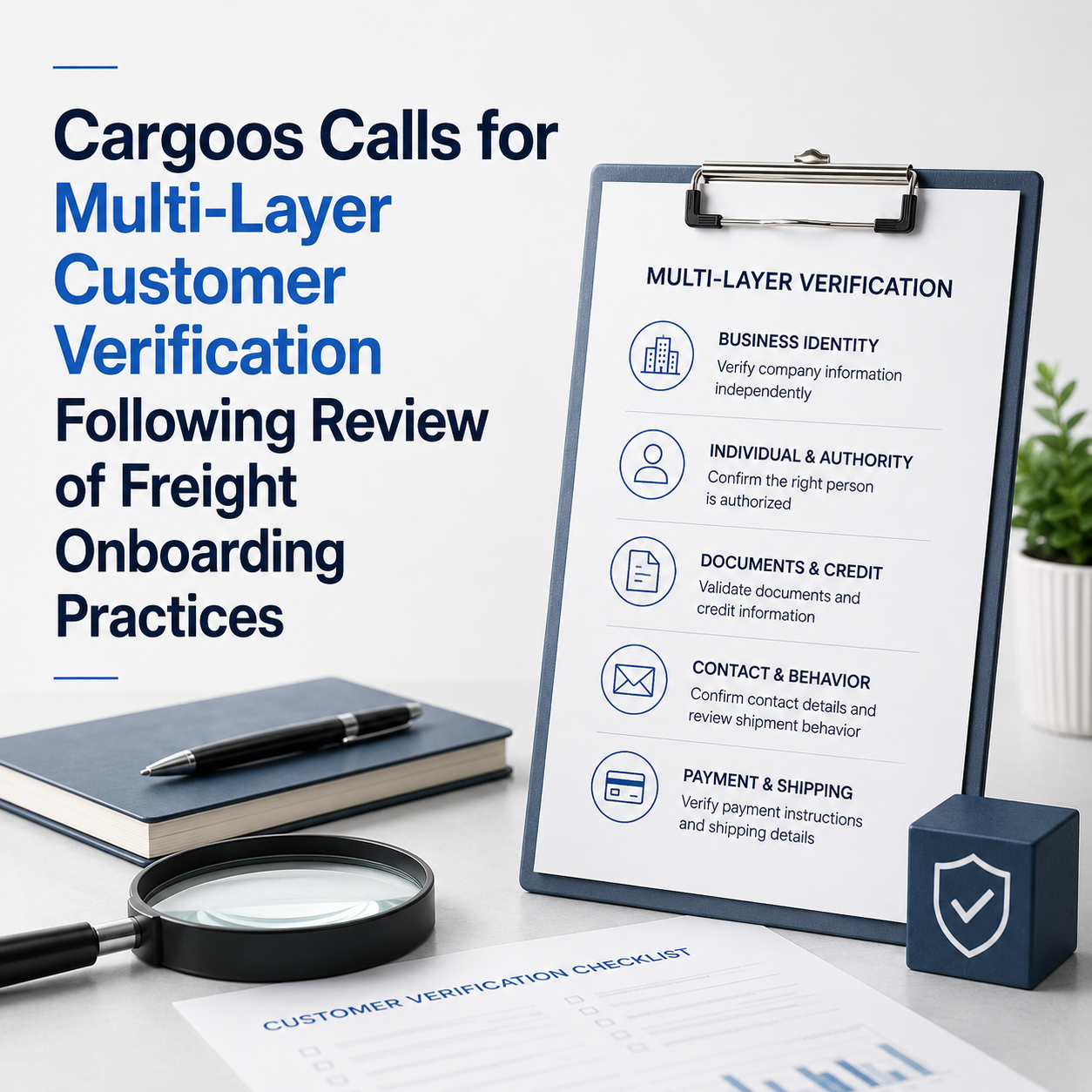
As part of its review, Cargoos examined how company identity, individual identity, authority to represent a business, credit information, contact details, supporting documents and shipment behavior can be evaluated together during customer onboarding.
The company’s conclusion is that documentation remains essential, but individual documents should not be relied upon as the sole basis for approving a new commercial relationship.
“Our first lesson was that customer verification deserves the same level of attention we give other parts of the freight transaction,” said Artur Gronus, CEO of Cargoos Logistics. “The next question was what stronger verification should actually look like. For us, it means making sure several independent pieces of information support the same conclusion.”
From Document Collection to Cross-Verification
Traditional customer onboarding commonly involves collecting tax documentation, credit applications, company information, references and signed agreements.
Cargoos is expanding its internal approach by placing greater emphasis on cross-verification.
Information supplied by a prospective customer can be compared with independently obtained business records. Contact information can be verified separately from submitted documentation. An individual’s position and authority to act on behalf of a company can also be confirmed through an independent channel when appropriate.
The objective is not simply to collect more documents. It is to determine whether the company, contact, documentation and proposed transaction are consistent with one another.
Cargoos says additional review may be appropriate when several inconsistencies appear together, including differences in contact information across records, unexpected email domains, difficulty confirming an individual’s relationship with an organization, unusual urgency surrounding account approval, or unexpected changes to shipping or payment instructions.
These factors do not necessarily indicate improper activity individually. Cargoos believes they are most useful when considered collectively as part of a structured review.
“One inconsistency may have a reasonable explanation,” Gronus said. “When several pieces of information do not align, additional verification can help clarify the situation before credit is extended or freight begins moving.”
Verification Beyond Initial Onboarding
Cargoos also believes customer verification should not necessarily end once an account is approved.
Freight transactions can involve multiple contacts, carriers, drivers, receivers, documents and payment instructions. Information may also change during an active business relationship.
A request involving a new contact, different payment instructions, an unexpected shipping location or another significant change may justify an additional verification step.
The approach reflects a broader shift toward treating verification as an ongoing operational process rather than a one-time document review.
Balancing Security With Speed
Cargoos acknowledges that transportation companies must balance stronger verification with the speed expected by legitimate customers.
Rather than creating unnecessary barriers, the company says structured procedures and technology can help identify which information can be verified routinely and which situations warrant additional review.
“Good verification should support legitimate business, not slow it down unnecessarily,” Gronus said. “The goal is to identify inconsistencies early, verify the information that matters and allow legitimate customers to move forward efficiently.”
Cargoos is incorporating lessons from its recent internal reviews into its customer onboarding and risk-management procedures.
The company plans to continue sharing practical observations related to freight verification, operational risk and responsible customer onboarding as transportation transactions become increasingly digital and interconnected.
Jaymie Freeman
Cargoos Logistics
+1 312-772-4422
email us here
Visit us on social media:
LinkedIn
Facebook
X
Other
Legal Disclaimer:
EIN Presswire provides this news content “as is” without warranty of any kind. We do not accept any responsibility or liability
for the accuracy, content, images, videos, licenses, completeness, legality, or reliability of the information contained in this
article. If you have any complaints or copyright issues related to this article, kindly contact the author above.

Media gallery